Negotiating Equity @ a Startup – Stock Option Counsel Tips

Attorney Mary Russell counsels individuals on startup equity, including:
You are welcome to contact her at (650) 326-3412 or at info@stockoptioncounsel.com.
Negotiating an offer from a startup? Here's some tips.
1. Know How Much Equity You Want
For employees early in their careers, the only negotiable terms for equity are the number of shares of stock and, possibly, the vesting schedule. The company will already have defined the form in which you will earn those shares, such as stock options, restricted stock units or restricted stock.
Your task in negotiating equity is to know how many shares would make the offer appealing to you or better than your other offers. If you don’t know what you want for equity, the company will be happy to tell you that you don’t want much.
Your desired number of shares should be the result of thoughtful consideration of the equity offer. There is no simple way to evaluate equity, but understanding the concepts and playing with the numbers should give you the power to decide how many shares you want.
One way to compare offers and evaluate equity is to find the current VC valuation of the preferred shares in the company. If a VC has recently paid $10 per share for the company’s stock, and you have been offered 10,000 shares, you can use $100,000 to compare to other offers. If another company has offered you 20,000 shares, and a VC has recently paid $5 for their shares, you could use those numbers to compare the offers. For more info on finding VC valuations, see: Startup Valuation Basics or contact Stock Option Counsel.
Remember that the purpose of this exercise is not to have a precise dollar value for the offer, but to answer these questions: How does this offer compare to other offers or my current position? What salary and number of shares at this company would make this a stable, sustainable relationship for me? In other words, will this keep me happy here for some time? If not, it is in nobody’s best interest to come to a deal on that package.
For more information on negotiating equity, see our video: Negotiate the Right Stock Option Offer or our blog with Boris Epstein of BINC Search: Negotiate the Right Job Offer.
2. Look for Tricky Legal Terms That Limit Your Shares' Value
There are some key legal terms that can diminish the value of your equity grant. Pay careful attention to these, as some are harsh enough that it makes sense to walk away from an equity offer.
If you receive your specific equity grant documents before you are hired, such as the Equity Incentive Plan or Stock Option Plan, you can ask an attorney to read them.
If you don’t have the documents, you will have to wait until after you are hired to study the terms. But you can ask some general questions during the negotiation to flush out the tricky terms. For example, will the company have any repurchase rights or forfeiture rights for vested shares? Does the equity plan limit the kinds of exit events in which I can participate? What happens to my equity if I leave the company?
3. Evaluate the Equity’s Potential
Evaluate the company to know how many shares would make the equity offer worth your time. You can start by asking the company some basic questions on their expectations for future growth and the exit timeline.
The higher your rank in the company and the stronger your emphasis on these matters, the more likely you are to speak to the CEO, CFO or someone else at the company who can answer these questions. If you want more resources to help you think like a startup investor, there are great online resources on valuation, dilution and exits for startups.
But don’t place too much weight on the company’s predictions of the equity’s potential value, especially if those values are based on an early-stage company’s Discounted Cash Flows (DCF). Even the experts know that the only thing early stage startups know about financial projections is that they are wrong.
Attorney Mary Russell counsels individuals on startup equity, including:
You are welcome to contact her at (650) 326-3412 or at info@stockoptioncounsel.com.
Stock Option Counsel Tip #1
Attorney Mary Russell counsels individuals on startup equity, including:
You are welcome to contact her at (650) 326-3412 or at info@stockoptioncounsel.com.
Use @angellist to research "market" equity for your company size. https://angel.co/jobs #equity #negotiation #startup
Exercising an Incentive Stock Option (ISO)? Should You Hold the Stock?
This is a guest post from Michael Gray CPA. He counsels individuals on their employee stock option tax questions. For more employee stock option tax resources, see Michael Gray, CPA's Option Alert at StockOptionAdvisors.com.
When you have decided to exercise an incentive stock option (ISO) and consider the federal alternative minimum tax (AMT) and the net investment income tax, the benefits of holding stock after exercising an incentive stock option are reduced. The "brass ring" of having the gain from the sale of the stock eligible for long-term capital gains rates (15% or 20%) seems attractive, but the 28% alternative minimum tax rate applies
for the excess of the fair market value of the stock at exercise over the option price ("spread") when the option is exercised. (California also has a 7% alternative minimum tax. Find out the rules for your state.) The minimum tax credit for this tax "prepayment" is hard for many taxpayers to recover, because they are already subject to the AMT, due to deductions disallowed for the AMT computation, including state income taxes, real estate taxes and miscellaneous itemized deductions. That means the "spread" at exercise is probably
going to be taxed at a 28% federal tax rate when the dust settles.
In addition, long-term capital gains are subject to the 3.8% net investment income tax when the taxpayer has high adjusted gross income. That means the total federal tax rate for the initial spread would be 31.8%, versus a maximum federal tax rate of 39.6%. Is an 8% tax benefit worth the risk of exposure to market volatility of the stock? It could fall much more than that.
The main time it makes sense to hold the stock is when the "spread" is low and the option price is low. Then you can probably afford to pay for the stock and AMT (if any) and to take the risk that the value of the stock could fall. When you do this, you forgo the "time value premium" for the option. If you have the alternative of just buying the stock for about the same price without exercising the option, you will probably be in a better position by doing that, because you will still have the options to exercise if the value of the stock increases with no downside risk for the options.
An alternative is to exercise the option and immediately sell the stock, provided the stock is publicly traded or there is a "liquidity event" such as a sale of the employer company. In that case, the gain will be taxed as additional wages, subject to federal tax rates up to 39.6%, but exempt from employment
taxes such as social security and medicare taxes.
These are general comments. You really should meet with a tax professional familiar with incentive stock options (that's our business!) to discuss your individual situation and have tax planning computations done. To make an appointment with Michael Gray, call Dawn Siemer at (408)918-3162 on Mondays,
Wednesdays, Thursdays or Fridays.
This article was published in the September 24, 2014 Option Advisor Alert. Republished with permission.
From The Daily Muse
Attorney Mary Russell, Founder of Stock Option Counsel based in San Francisco, advises that anyone receiving equity compensation should evaluate the company and offer based on his or her own independent analysis. This means thoughtfully looking at the company’scapitalization and valuation.
Attorney Mary Russell counsels individuals on startup equity, including:
You are welcome to contact her at (650) 326-3412 or at info@stockoptioncounsel.com.
Thanks Ji Eun (Jamie) Lee for the mention in The Daily Muse!
“Is This the Right Company?
Investors buy equity in a company with money, but you’ll be earning it through your investment of time and effort. So it’s important to think rationally, as an investor would, about the growth prospects of your start-up.
Attorney Mary Russell, Founder of Stock Option Counsel based in San Francisco, advises that anyone receiving equity compensation should evaluate the company and offer based on his or her own independent analysis. This means thoughtfully looking at the company’s capitalization and valuation. ”
Attorney Mary Russell counsels individuals on startup equity, including:
You are welcome to contact her at (650) 326-3412 or at info@stockoptioncounsel.com.
Skype Repurchase Rights = Vampire Capitalism
I agree that it is unethical as it goes against the expectation of employees as to how their contributions are valued. If they don't know about it before they choose the company, they are making a choice without an essential term of the deal.
And it goes against the most idealistic ethic of Silicon Valley – that capitalism should be used by groups to organize and cultivate their own creative efforts rather than as a tool of vampires.
But it is not illegal. And I've seen worse in my Stock Option Counsel practice (twice this month alone). Congratulations on paying attention.
Attorney Mary Russell counsels individuals on startup equity, including:
You are welcome to contact her at (650) 326-3412 or at info@stockoptioncounsel.com.
Quora Question:
What does it say about a company that has a Skype-like repurchase right in their stock option agreement? The company that I work for has a stock option agreement that has a Skype-like repurchase clause (See: Upgrading Skype and Silver Lake to Evil), basically allowing them to buy back exercise stocks at 1.5x FMV within 90days following the employee's end date/exercise date. I have never seen anything like this, is this to protect them/screw ex-employees? It basically mean my vested stocks can be easily bought back at 1.5x? Isn't it unethical?
Stock Option Counsel Answer:
I agree that it is unethical as it goes against the expectation of employees as to how their contributions are valued. If they don't know about it before they choose the company, they are making a choice without an essential term of the deal.
And it goes against the most idealistic ethic of Silicon Valley – that capitalism should be used by groups to organize and cultivate their own creative efforts rather than as a tool of vampires.
But it is not illegal. And I've seen worse in my Stock Option Counsel practice (twice this month alone). Congratulations on paying attention.
Attorney Mary Russell counsels individuals on startup equity, including:
You are welcome to contact her at (650) 326-3412 or at info@stockoptioncounsel.com.
Best of Blogs: How to Value and Negotiate Startup Stock Options
NOTE: Updated February 23, 2016.
Attorney Mary Russell counsels individuals on startup equity, including:
You are welcome to contact her at (650) 326-3412 or at info@stockoptioncounsel.com.
We have suggested the following free resources to Stock Option Counsel clients to help them master this area and gain confidence in negotiating their stock options and other employee stock.
1. Leo Polovet's' Analyzing AngelList Job Postings, Part 1: Basic Stats & Part 2: Salary and Equity Benchmarks
2. Venture Hacks' I have a job offer at a startup, am I getting a good deal?
3. Andy Payne's Startup Equity for Employees
4. Mary Russell's Startup Equity Standards: A Guide for Employees
5. Wealthfront's Startup Salary and Equity Compensation Calculator (This is very general but people find it helpful.) And Wealthfront's The Right Way to Grant Equity to Your Employees.
6. Patrick McKenzie of Kalzumeus Software's Salary Negotiation: Make More Money, Be More Valued
7. Piaw Na's Negotiating Compensation, from An Engineer's Guide to Silicon Valley Startups
8. mystockoptions.com's How does a private company decide on the size of a stock grant? (You may have to create a login)
9. Michelle Wetzler's How I Negotiated My Startup Compensation
10. Mary Russell's Video Negotiate the Right Startup Stock Option Offer, based on Mary Russell and Boris Epstein's Bull's Eye: Negotiate the Right Job Offer
11. Mary Russell's Joining An Early Stage Startup? Negotiate Your Salary and Equity with Stock Option Counsel Tips
12. Robby Grossman's Negotiating Your Startup Job Offer
13. John Greathouse's What The Heck Are My Startup Stock Options Worth?! Seven Questions You Should Ask Before Joining A Startup
14. David Weekly's An Introduction to Stock & Options for the Tech Entrepreneur or Startup Employee
Attorney Mary Russell counsels individuals on startup equity, including:
You are welcome to contact her at (650) 326-3412 or at info@stockoptioncounsel.com.
Negotiation Rhythms #2: Best Alternative to Negotiated Agreement
Attorney Mary Russell counsels individuals on startup equity, including:
You are welcome to contact her at (650) 326-3412 or at info@stockoptioncounsel.com.
We know we want to push beyond our limits to capture as much value as possible in a negotiation. But how do we define those limits? It takes a five-word phrase to bring this concept into focus: Best Alternative to Negotiated Agreement (“BATNA”).
The BATNA for a car buyer might be the same car at a nearby dealership for $20,000. The BATNA for a home seller might be an offer from another party for $1 million. The BATNA for a child trading baseball cards might be to hold onto his favorite cards and enjoy looking at them rather than to trade them away.
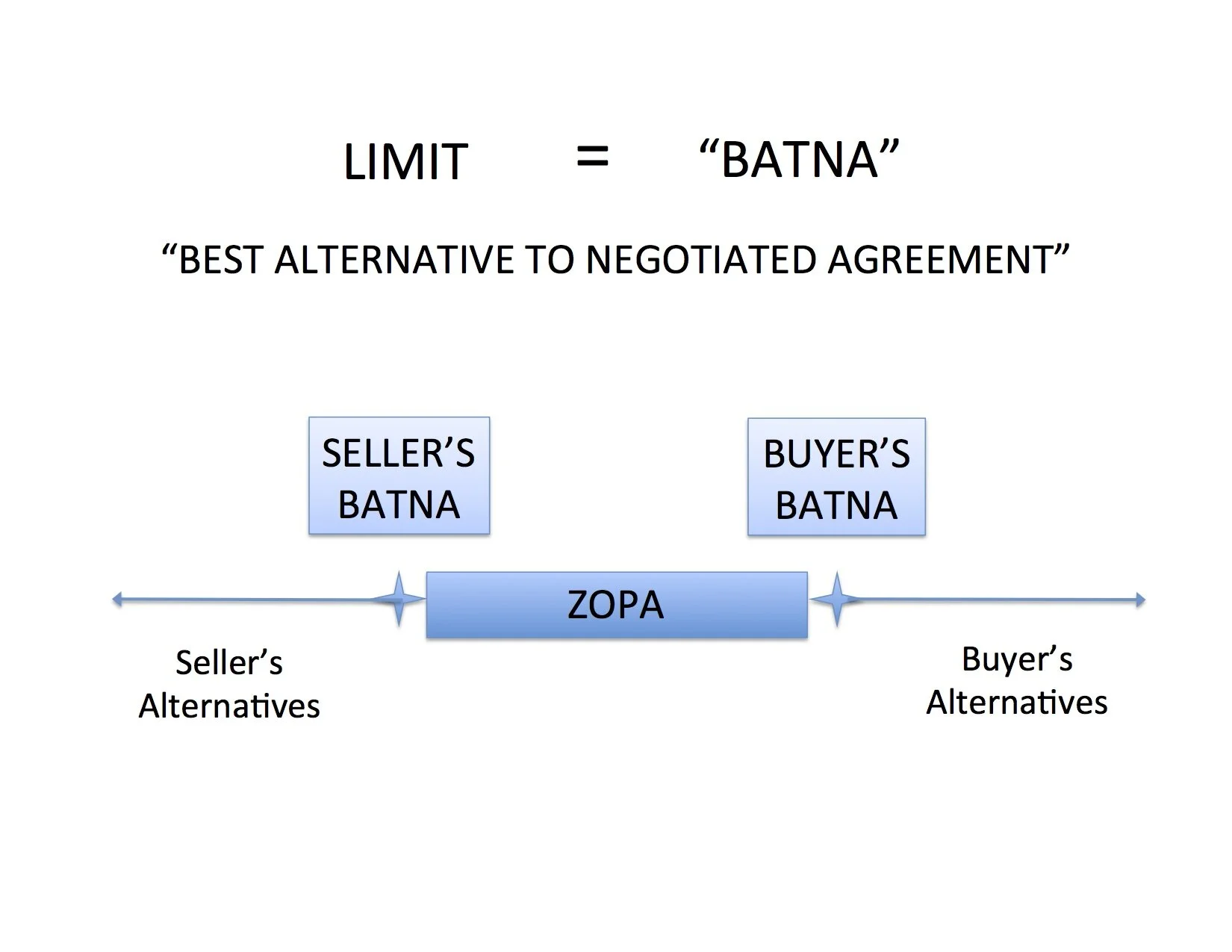
Salary Negotiation Method - Identify your BATNA, or best alternative to negotiated agreement, to find out if there is a ZOPA, or zone of possible agreement.
Any agreement below (or, for a maximum limit, above) a BATNA would leave the negotiator worse off than in the absence of that particular agreement. Said another way, the negotiator would be better off with some other option – their BATNA – than accepting an agreement on those terms.

Salary Negotiation Method - Identify your BATNA, or best alternative to negotiated agreement, to find out if there is a ZOPA, or zone of possible agreement.
To properly identify a BATNA, we must do a lot of calculating, daydreaming, and going out in the world to test alternatives. But this creative process is necessary. When we believe that the only alternative is the one at hand, our negotiation position is dangerously weak. It is also dangerously ineffective because it leads to an arrangement that does not, in fact, make the negotiator better off than without it. And any deal that is not in both parties’ best interests is unstable and likely to collapse after it is made.
Countless factors go into naming and ranking one’s alternatives to arrive at a BATNA, and even then it is impossible to do so clearly as those factors cannot all be outlined in numerical format. A better offer might be less certain of being completed, so it might be more advantageous to make an agreement on less favorable terms today. For example, the other job offer might not be certain even though it appears it would be more advantageous if it were finalized. This is the old saying that a bird in the hand is better than two in the bush, and this can be dangerous for those who optimistically negotiate as if their imaginary alternatives are already in the hand. In the other extreme, this is very limiting for those who are very fearful of uncertainty, as they will accept disadvantageous terms for the simple purpose of having certain terms when a bit of risk in pursuit of a better alternative could have led to greater results.
Timing is important in other ways as well, as a negotiator with more time to come to an agreement will have more chances to find alternatives to the agreement at hand. "Wait and see" becomes a BATNA in itself. The opposite of this would be a party who must have resolution today, which would, of course, limit the alternatives.
Beyond hard limits on time, some people do not enjoy the back and forth process of negotiating. They might prefer to take this deal, and even to accept much less of the middle than is possible to capture, than to continue to seek alternatives or negotiate deals. For these people, the process itself inhibits the growth of BATNAs.
We’ll see in the next post – Negotiation Rhythms #3: Sales & Threats – how brainstorming or eliminating BATNAs changes the ZOPA and improves or weakens our force in negotiation.
Attorney Mary Russell counsels individuals on startup equity, including:
You are welcome to contact her at (650) 326-3412 or at info@stockoptioncounsel.com.
Startup Stock: Particles and Waves. Casinos and Creativity.

Photo: Bobby Mikul
Attorney Mary Russell counsels individuals on startup equity, including:
You are welcome to contact her at (650) 326-3412 or at info@stockoptioncounsel.com.
What is a corporation? Finance pros and justice types present two very different answers to that question.
On the finance side, a corporation is a casino-style financial arrangement between those who own stock. It divides up the rights to a financial return on capital. It emphasizes balance sheets and stock prices and risk and return to support the view that each corporation is a table in a casino that investors approach to place their investment bets and seek a financial return.
On the human advocacy side, a corporation is a living body made up of creative individuals. The liveliness of the group – defined to include investors, managers, employees, and, perhaps, the community or the earth – is the purpose of the corporation. They make comparisons to slavery, define externalities and articulate their values to support their view that a corporation is a living body that could not be owned.
Like a ray of light, which is at once a wave and a group of particles, the corporation is both a casino game for investors and a living, creative body. Evidence will always appear on both sides of this truth.
In choosing a career path and negotiating compensation, we use both perspectives. We find a place that has some life to it, to which our creative contribution can add life. But we tune into the casino view as well and seek compensation for the risk we take in joining the enterprise. This requires the eye of an investor who would look at the risks of the bet and the size of the possible return from every angle with the help of professionals in law, finance, technology, etc.
It would be distasteful to take this view of our work every day, but it must be done at some time. And it is best done with Stock Option Counsel. This blog will introduce the Stock Option Counsel perspective on the risk / investment that employees take / make in accepting stock options or other equity as compensation. It should be helpful to those evaluating their compensation and also reveal the points in time in which Stock Option Counsel can add value in this process.
Attorney Mary Russell counsels individuals on startup equity, including:
You are welcome to contact her at (650) 326-3412 or at info@stockoptioncounsel.com.